Dr. Lovecraft

Dr. Lovecraft
Your humble host...

Thursday, May 13, 2010

Caravan • if i could do it all over again, i'd do it all over you (Decca, 1970)


Wandering around St. Marks last night with nothing much to do, but nursing a compulsion to just go...somewhere...I had the misfortune of spotting someone from my recent past. That event triggered another memory. About two years ago when I was working in Manhattan, I had become a host to a molecular dignitary. And as all hosts, I had to show this visiting dignitary the sights of New York. Regretfully the transfer is never easy on the host and symptoms not unlike influenza ensue. There I was hoping to show the sights of my beloved city, but I was unable to function...and at the same time I was starting a new job.

My guest understood and promised me that it would leave as soon as transfer was possible. For the sake of learning forgotten and black listed knowledge one suffers, and I did. Chills, excessive body mucus, aches, all forms of indignities. I had a new job to do - beside still housing the dignitary, so the option of sitting out and staying home could not be done.

While making my way home early one afternoon, I passed through Union Square. My guest was amazed at the upright growth of our plants. Regretfully this was in the winter so it would miss the flowering. I'm not exactly sure if the dignitary would understand the concept of flowering plants. I had once visited where it was from. It is a world of fungoid dominance and murky sky's. Just the way some places in the universe are. At the far end of the park facing the then Virgin Megastore was a group of easily 30 young people having a pillow fight. My host apologized for now the induction of hallucinations and once again stressed to his transfer point the necessity of his departure. Even I wasn't too sure if what was unfolding before me was really there - but when a feather landed gently on my jacket sleeve and I could pick it up, we both realized that this was indeed real. We stood there watching a joyful outburst of levity. Keep in mind that this was in the waning days of the Bush/Cheney administration, so at some point the pressure valve was going to blow. This is a phenomenon noted before, if you'll refer to Artaud's (1846-1948) essay on theater during plague, you will get a much more detailed explanation.

In one of the much treasured moments of synchronicity, the overstuffed feather pillows flew through the air in acts of soft edged aggression. In my iPod headphones played Caravan's second LP "if i could do it all over again, i'd do it all over you". Perfectly complimenting the heavy slow motion swings of the pillows was the laid back intensity that Caravan is noted for. While it is true that Caravan share too many similarities with The Soft Machine, from the near identical vocals between Wyatt and Sinclair and use of overamped Lowery organ, these are the same similarities that like species share. Lemurs and Chimpanzees are both primates, but there is that one or two things that keep them from being confused for each other in the dark. Caravans saving grace is their song form. While the Soft's were more adventurous in playing amorphous compositions that bordered on jazz, Caravan's strength was pop songs stretched out without sounding forced. This is best served by their ability to play slowly without sounding like they are plodding along. I must admit that I do not know much of the Caravan catalog - having only also the first and third lps, so I'm not sure if this style of playing holds out. The first record released on Verve is second tier psychedelia and had turned me off to the band, and the third record the lyrics get too close to Hobbitville for my liking but the fantastic playing over shadows.

Please click on the review title for the selected track: With An Ear To The Ground You Can Make It / Martinian / Only Cox / Reprise

Sunday, April 11, 2010

The Velvet Underground • The Velvet Underground (MGM, 1969)

Everything that needs to be said about this band has been said. The perfect marriage of joyful nihilism and the infinite drone, New York's twisted stars meaning every word that they sang. All of it is true, and while I particularly love the first two records (The Velvet Underground & Nico, and White Light/White Heat), there is a part of me that enjoys the personal yet obscure song cycle of the third record.
What the gender is of the objects of Reed's observations isn't important. Man or woman, both seemed to house a mystery about love that he couldn't unravel. Love leaves you asking about where you are, and silently moves you to a place where you are alone wondering where you had been. Try rooting through a box of love letters and listen to this record in its entirety - you will get it.
After the hard as nails sonic assault of White Light/White Heat there was a wise move away from that sound. It has been assumed that due to Cale's dismissal from the band and the subsiquent theft of the band's distortion pedals was the cause. I'm not sure I buy that. Cale's first solo record "Vintage Violence" is in the same well crafted pop calmness of the third Velvet's record, only slightly more polished. Perhaps Reed saw that the band was in danger of becoming a parody of its self and he pulled in the reigns. Either way, what was produced had to be one of the more intelligent records of 1969. The lyrics would have been lost in the frenzy of the previous style of the first two records. Perhaps the only glimps of what was to come would be the song "I'll Be Your Mirror", and even then there is a menace to the words.
While their association to the underground waning from the firings of Warhol and Cale, The Velvet Underground were still capable of producing a track of sonic distress for the squares who might have been lulled into the record with its softer playing style. "The Murder Mystery" is the aural equivalent of Anthony Balach's The Cut Up's. Two audio tracks of word salads are recited simultaneously - each getting their own speaker. Read recites in a computer like monotone, while I suspect from the heavy Long Island accent Sterling Morrison reads at a rapid clip. The words intertwine around each other forming new images. Something about Nuns on the sea wall finishes the though of sailors who couldn't menstruate, but all the while nothing is really resolved. While this track seems out of place from all that has come before it, I have always wondered if it's placement was symbolic to the confusion on experiences ruminating over lost love.
Please click on the review title for the selected track: The Murder Mystery.

Tuesday, February 16, 2010

cosmos factory • cosmos factory (Columbia,1973)

Occasionally I am asked questions of a philosophic nature; "am I dying meester?", "will this operation bring intimacy back to our marriage", or "why do I only have one eye"...can't tell you how many times I've had to field that one...but every once in a while I get my most favorite. Coming out of the post operation anesthetic a patient will groggily ask "what is the invisible glue and cartilage that holds existence together". Now I am well versed in medical procedures, and I suspect it is because of this the common extension of logic is that I would know how things really are. Sadly to say I have been to all for corners of the universe (and yes there are four - they tend to fold in on themselves but I'll explain that another time) and I am at times equally at a loss as to what hold it all together. For a while I had thought that anger and the desire to survive was one of the essential ingredients. That theory had gone out the window when I met the fearsome Ellacultos. At that point of their evolution they hand willfully mutated into a sort of plant / machine. Somehow by that advancement in their physiology they had bypassed the problems associated by most animals. Now they only craved logic. With amazing quickness other empires had crumbled around them, and yet the Ellacultos still were dissatisfied. Now that they had survived, what was the point. There were no possible challengers in their section of the universe, and while the need for successful expansion of empire was alluring, it was all hollow victories after all. As they were now a Plant / Machine combination, individuality was extracted. When the death march of boredom started up, a new unthinkable idea was presented - suicide. In mass the Ellacultos returned to the planet that started the outward migration and proceeded to fight amongst themselves. Knowing that the direct mindedness of being part machine would get them to fight to the death, each and every one of them had a war. After roughly a few weeks the population was dead. I had always speculated that the decision for this action was not philosophical, but that of a malfunction of computer circuitry. Thankfully the electronics that made them what they were isn't that easily back engineered...that doesn't mean that it won't be, but for now we are safe...

So where does that leave us, well for me I am grateful that the fern on my mantel doesn't harbor any designs for conquest and listening to Cosmos Factory self titled first lp. I believe I have written in previous posts my affection for Japanese rock. Like most things from Japan that are based on western ideals - they get it so close, but then something goes wonderfully wrong. Where the Germans could have a fair grip on singing in English, far easterners just can't seem to do it. Something wrong happens - tongues that are not equipped to the various Latin based letters and consonants flop warily around, producing something not unlike singing backwards.

Opening with a Mort Garison / Movie of the Week like instrumental called "soundtrack 1984", we then dive head long into heavy Hammond Organ and angelic choir vocals territory of "Maybe". This song, like all the others are sung in Japanese, keeping the otherness intact. Perhaps there are some Bowie like inflections detectable, but the confidence of the band saves this from being a maudlin copycat.

Maudlin or perhaps even turgid the best way to describe the overall tone of the record. From the cover and gatefold depicting decay and abandonment, to the songs where everything is just short of pop Wagner. This is not a light and uplifting album. If everything is going to crap in your life that that moment, you may want to keep the suicide prevention hot line on speed dial. These are the Quaaluded Spiders from Mars. Thankfully there is a slightly less apocalyptic song "Soft Focus", that uses a sort of Asian sounding melody, but it is moody none the less. The second side of the record is comprised of the four part suite "An Old Castle Of Transylvania". It is everything you would expect with a title like that; mysterious organ chords, distorted guitars, spooky Mellotron fills, and more end of the world vocalizing. If Jean Rollin shot his Vampire films in Japan instead of France, Cosmos Factory would have supplied the perfect score.

I have seen this album listed as An Old Castle Of Transylvania, but nowhere is that used beside as the title for the suite. What is listed on the back cover is Merry go round. Was this at one point the working title of the record?

Cosmos Factory would go on to make three other records, that I am yet to hear. Apparently the follow up to the first record was a electronic soundtrack, and then the remaining two are in the vein of heavy metal. I hope that isn't true for the last true, I would hate to think that in a attempt to keep things going that there was a retrograde of intelligence.


Please click on the review title for selected track: Maybe.

Wednesday, February 10, 2010

Steven Stapleton & David Tibet • The Sadness Of Things (United Dairies, 1991)


Your good doctor is in a bit of a quandary, and taking a walk in the snow currently blanketing New York has not made things any clearer. I'm not sure if I had witnessed a car wreck, nervous break down, a bad power struggle, infidelity, anima dimorphism, imaginary lycanthropy, or any other form of what the hell was that a few months ago. Regretfully I am a man driven to get to the bottom of things. Had I only picked up a different match book and filled out the coupon, my entries would be written by the aesthetics a different hand. That appendage would be one guided by the mind of a private investigator. While my psyche has been honed to look for signs of malignant growth, or even host parasite imbalance, and these are detecting skills, I wish I was better suited to the world of mind and motivation.

When I find myself in such a state, wondering what has happened, or perhaps even my role in unfolding events, one can either chose music that numbs all thought or enhance it. To perform audio anesthetic I would opt for something ridiculous not unlike T.Rex or even Esquivel, but for moments of reflection the nod must be given to Steven Stapleton and David Tibet's apex of inner-space; The Sadness Of Things.

Sprawled out across two tracks is the fog of contemplation and melancholia. The title track begins with a slow and steady drumbeat, not unlike something one hears at the finer temples in Lasha Lasha. A mournful wooden flute pipes lonely against a indecipherable electronic fog. As this builds in stately momentum a girls voice intones "I am not born. I do not die". Her voice is assured, very much like the words of the departed - not connecting with any event in the room, but still with intention of place. This is the ritual that draws you out of your body and allows you to look down and see that the world was really constructed of back lots and extras. Mono no aware? Most certainly. There are things in this world that will never be fully understood. Nuances is all one can gather, and even then to study it too long its inner workings become various and open ended. No answer is forthcoming. Eventually all one learns is that cruelty is one of the easier actions we are capable of. You walk away muttering the sadness of things. Such is the music of the first track. With a stringent viola line working its way through the gauzy haze eventually David Tibet appears. With a somnambulists dedication he reads bewildering lines asking where the years have gone. By the simple magick of sound he has helped you through your quandary. What is unknown can be left aside, content we are that some mysteries are the sum total of themselves. Now the great work can begin.

By the second track; The Grave And The Beautiful Name Of Sadness, you are fully dislodged and now among the protoplasm and dark mater that holds existence together. With just human voice and echo, Stapleton glides you to somewhere. Yet it seems the trip is more important than the destination. Are these the voices of the departed we hear and are they just sounding off in the fog, with no definitive omens to come for the living?

It seems that this CD has gone out of print and there are no immediate plans to reissue it, which is a shame. Of the collaborations that Stapleton and Tibet have lodged under their names, not just under the designations as Nurse With Wound or Current93 this is some of their most powerful work. Equally a shame is the scarcity of the CD. Used copies are almost impossible to come by, and most due to a mastering issue have disc rot.

Please click on the review title for the selected track: The Sadness Of Things.

Saturday, January 23, 2010

pearls before swine • balaklava (ESP-DISK, 1968)

My absence is unbecoming, and please accept my most humblest of apologies. Where have I been you may ask, I wish I could say that my travels have taken me to the exotic shores of Nebulae 12, with the natives neither wholly plant or machine. Or even that of the molecular with trapdoors awaiting with every ignorant turn. No, nothing as harrowing was the cause of my disappearance. My terrestrial employment had relocated to Long Island City, and the commute was not conducive to writing, I am sorry to admit.

Let us not dwell on such unpleasantness. The world can do that on it's own and it doesn't really need our help. We are seekers of sound new and old. That is our concern.

One of those Old and New sounds would be Pearls Before Swine's late 60's masterpiece - Balaklava. This jewel of folk melancholia was introduced to me by I. Vale in the mid 80's. From the spoken word opening from Trumpeter Landfrey, one of the last surviving trumpeters of The Charge of the Light brigade followed quickly by a song that sounded unlike anything that was labeled "the 60's". What was this sound? A acoustic guitar bathed in reverb, spoken word philosophy couplets, and heavy breathing. We were hooked.

Early in my listening carrier I was not a huge fan of acoustic music, it just seemed so empty. Thankfully this record set my ear afire with it's simplicity. This is not to say that it's all plain song, quite the opposite. Songs are often cradled by sound effects, and it is these effects that add to rather than flesh out the compositions. Guardian Angels, the stunning closer of side one would be nothing without the addition of 78 RPM scratches and drop outs. Could the gorgeous I Saw The World work without the shoreline sounds. It most likely would, due to the strength of the lyrics, but without it the song would be lacking. If I am stressing here the use of sound effects, it is by way of compensation. While the Pearls are now somewhat revered when remembered, at the time of my discovery most contemporary rock encyclopedias would list them as trivial LSD soaked oddities. These were the same books that heaped praise on the likes of the Almann Brothers and the Knack...and who says that that those books weren't ghost written by the staff at Atlantic or Epic...

All of the Pearls records were pretty much the vision of Thom Rapp (seated). He was most certainly responsible for the clever inward looking lyrics, but musically that's where it gets a little questionable. On this, their second record, not unlike the first, the music has a out of century quality. Just as Nico's The Marble Index could be songs from the 1500's with modern 8 track additions, the same could be said of Balaklava. The songs move with a air of American troubadour, but the whole section of backwards music smells of patchouli and modern technology.

The follow up record for Reprise, "These Things Too", continued with the Medieval art motif, but the original band was gone and the music reflects this. While never coming close to Singer Songwriter, every album after Balaklava has a creeping normality about it. This is not to say that James Taylor had anything to worry about, but the better tracks were getting few and far between. For every song like The Jeweler or Stardancer, you had Charley and the lady, or almost all of The City Of Gold LP.

Click on the review title for I Saw The World.

Thursday, November 5, 2009

Gerard Manset • La Mort D'Orion (EMI/Pathe/Zenon, 1970)

Another decade long trip around the sun I have just completed. In comparison to other things that this universe holds, that is a small time parlor trick.

While this involuntary action can illicit melancholy there is nothing one can do. You get older, along with everything else...

My ears have been soothed but the River Styx operetta that is La Mort D'Orion. In my previous post I gushed praise in Pearls Before Swine's Balaklava. That record record filled my younger years with hope that there was something else out there then the general music for knuckle heads and suburban idiots. How much of the 90's was spent in combat mode - G n' R at the ready? Now granted most of the items in this blog would never get played on a juke box (small aside; one time I found my self in a Queens biker bar located on Union Turnpike and put on Tomorrow Never Knows.I watched to my joy and amazement as the burly bar tender did a 60's shimmy go go dance to the pounding of Ringo Stars drumming). So where would this type of music get played? In darkened basements, downer parties, solo explorations of the cosmos and it's accompanying neither-worlds. How I wish I had known of Gerard Manset's recordings, what a perfect weapon it would have been back then against the hordes.

Not unlike the above mentioned Pearls Before Swine, the second record is the stunner. His first already had a quality that was odd for a projected pop star - snotty dismissive vocals not unlike Lou Reed in the 70's, sound effects, song forms that owe more to classical with no discernible middle eight. When coupled with coming out during the May 1968 riots, his debut sold next to nothing.

While history is littered with bands and performers that one wonders what it...and regardless of his idiosyncratic style and bad timing, he was given a second chance. How lucky he and we both are. Who knew that one man could translate out the map of decedent moroseness worthy of Hysman at his finest. This is the soundtrack to La Bas. Weariness permeates the musical proceedings, but at no point has Manset lost his virility. The orchestrations also by Manset are never fruity, but bold accents that bring this into a new territory that John Cale would explore in the Falklands Suite nearly twenty years later. I have mentioned the two of three monoliths of The Velvet Underground, and it is in way to say that Manset is lesser in their shadow. He is every part their contemporary, if not the secret genetic melding of Msr's Reed and Cale. It can happen you know, there was a genetic laboratory in Florida that was working on a ape human hybrid. Not for any practical purposes mind you, but the grant money had to be spent by fiscal years end.

Apparently the La Mort D'Orion was a hit in France, and praise must be given to Mansets moves after its wake. There were a minimum of interviews, no concerts, no plans for an English translation, even the followup singles' picture sleeve used the same black cover motif but it was a reworking of one the parent albums songs. Yet Manset became a star in France, selling records and becoming of an institution of solitude. Further testimony to his fame, the cartoonist Bilal did a whole work based on the album.

Regretfully Gerard Manset would never sail again the same psychotropic ocean. While every album has that same man alone feel, and he augments with his own orchestrations, gone were the tape collage segments and use of other voices. The records following La Mort D'Orion are still apocalyptic, but just slightly less so.

The original LP was published on EMI, but I am yet to see an original copy. It is very doubtful that it was ever released in America. There was a CD reissue sometime in the late 90's or early 00's, but this has gone out of print. What is available now is a gray area release by a suspect Korean label WPS. The sound quality is clear and must have come from the reissue. Thanks must be given to the person who did the mastering, for the sound is of high quality.

Please click on review title for La Mort D'Orion: La Mort D'Orion

Thursday, April 30, 2009

Captain Beefheart & His Magic Band • Trout Mask Replica (Straight, 1969)

I completely missed the anniversary. Earlier this month, 40 years ago Frank Zappa summoned the Captain and his Magic Band to his home studio for a preview of their assembled album. Dressed in Sunday best (after all, it was Easter) intently they listened. The Captain was overjoyed, the Band relived. Perhaps now they would be free of his artistic and physical cruelty. A year of living in absolute poverty and under near cult like circumstances had payed off. Little could they imagine that in the years to come, in reverent awe, people would still speak of this work.
For as wild as free jazz was, and that by 1968/1969 it was perfectly OK to sit and play your bongos in the dirt, nothing sounded like this. Keeping to the credo of mutations, with their awkwardly placed limbs causing a shambling gate, causing fear and revulsion to all they encounter, the music has the same frightening assault on the senses. To the untrained ear the music sounds wrong. Clashing time signatures - every instrument sounds in conflict. The Captains wounded animal howling vocals laying lyrics that are products of schizophrenia yet are deeply insightful. Ironically they seem to be concerned about how mean humans can be to each other. This is just too much for dull minds...
There have been scores of musicians that have attempted to incorporate the Magic Band sound, but it just hasn't worked. What makes the playing here so unique is the amount of control that is cleverly disguised. To the untrained, this just seems like a sonic free for all. If it was it just wouldn't have worked.
Little hints of regular rhythm here and there, but the melding of free jazz and delta blues seems to obscure anything below the surface. But if you stick with it you'll get it, just throw out the preconceived notion of what comprises a song. This is the sound of nature. Anima does not compose straight lines, and that rule applies here. A melody may only need to play 7 bars even though the song is 24 long, but it works. Any more and there would be excess, and in reflection of the times when album tracks were getting longer and longer the songs are economical. Can you imagine any other band getting 28 pieces on a double album?
1969 was the watershed year for 60's wretchedness - Woodstock, the accession of the Grateful Dead come readily to mind, but thankfully we have from that year an album that transcended music and became art.

Please click on the review title for the track: Hair Pie I / untitled / dialog / Hobo Chang Ba. These were taped at the Trout Mask House when the album was to be recorded there as a "Ethnic Field Recording". While they lack Vliet's vocals, his absence shows how complex and almost Rites Of Spring like the music is.

Saturday, April 18, 2009

Sun Dial • Other Way Out (Tangerine, 1990)

What are the elements of Deja Vu? It was once isolated to a fine gauze not unlike ectoplasm but some how less definite. As my colleagues and I finally were able to get the filament to materialize in the sterile confines of the glass tank, a cleaning person opened a window in the research facilities hallway and that very motion came a vague hint of a draft. With that seemingly insignificant action, the element was some how able to be whisked away and we were left with the feeling that we had seen this before, but couldn't tell why...

Sun Dial's Other Way Out album has that same quality. While released in 1990, with eyes closed you would swear that you were listening to a contemporary of early Pink Floyd or Czar. Didn't this band play U.F.O., why do I think I saw them open for The Crazy World Of Arthur Brown? I think I even have the concert poster around here some where, it was an Osiris production...

Their act of confounding time travel must be applauded. It was fashionable to embrace psychedelia then in idea, but the secrets of the kingdom was still slumbering. For as many portals were sighted, very few would open enough to let two people though at a time. Some how this three piece band was able to. The whole album reeks of a lived in past. Guitars are thick and intelligently distorted, real drums pound with conviction, straight forward bass playing, fazed vocals, and exotic flutes and percussion abound.

Knowing a good thing and being incredibly prolific in their first year of existence, head Sun Dial Guitarist Gary Raymond released a number of compilation tracks and reissued Other Way Out with different covers and track listings. Here is where things get confusing. No mention is made of what tracks were from the above mentioned compilations. As of 2006 Other Way Out is on its fourth reissue, now a double CD with the second disc containing outtakes and compilation tracks. The well know version of the album released on UFO Compact Discs was a relative contemporary of the Tangerine issue but had different mixes of the songs.

Either version is a stunning debut that very few pull off, and the lauding offered at the time was well earned. About the time of release, they made a short tour of the United States with The Fur and Skin Trading Club and I was lucky enough to see them. This would be I believe their only tour, and if they toured again in this configuration. Subsequent Sun Dial recording would have only Raymond as a mainstay and the quality of records suffers. His side project Quad continued the same lysergic quality that has made Other Way Out a perennial favorite among connoisseurs, but regretfully the Quad recordings were limited issues and are now hard to come by. Hopefully he will one day release them on CD.

Until then we still have these recordings to sit back and let the intangible element known as Deja Vu to caress your ears.

Please click on the review title for selected track: Plains Of Nazca take one

Tuesday, February 3, 2009

Kenneth Anger (2.3.37 - )


February 3rd marks the 82nd birthday of Kenneth Anger. If for some odd reason you don't know that name, how you have survived through this journal is beyond me...that said, Fantoma has released in the past year or so two DVDs collecting his films. Go watch.

Much has been written about how he almost single handily started the music video, or that this was the first gay cinema to receive a wide audience, and his connection to The Rolling Stones / Led Zeppelin / Charles Manson, etc. All of that is true, but if you can watch the works with out the post modern malady of explaining everything, you will be rewardingly immersed in a world of frightful symmetry - Jungian ideas flying toward your subconscious with strobe light precision, and the self shrouded mysteries of Magick tantalizingly revealed.

For someone with a vast reputation he has surprisingly a small catalog. There are rumors of other titles, but either they are part of Anger's own myth making or they do exist and will be shown after his passing. I am never sure which to believe. But what is available is enough to keep me coming back. With each viewing I find new visual layers not perceived from the last time. These are films shot on limited budget yet they are amazing in their opulence. For a few minutes - his longest work runs roughly 38 minutes, the outside world falls away and you are transported to the time of Busby Berkley and the smell of opium...it is for these feats of Magick, I say Salute!

Monday, January 26, 2009

Blue Öyster Cult • Secret Treaties (Columbia, 1974)


When a mathematically inclined woodland creature admonishes you for your absence, you get writing...

Last night I was wandering around in the near frigid weather with a good friend, N. No Aswang is he, but not unlike the dreaded creature who disembowels it's self from it's lower torso to hunt, N's brain during the evening leaving the constraints of the day behind and is equally free to roam. As we wandered from place to place, he informed me in his inimitable way that perception is 9/10th of everything, and that his original perception of me was someone who is brooding, even slightly mean. But of course he has come to see the error in judgment. Yes, I have a perpetual furrowed brow, but it is just from contemplating how to perform some social operation better...

The same could be said of Blue Oyster Cult. Almost everyone is aware of the later hit singles - Don't Fear The Reaper, Godzilla, or even their somewhat flaccid peon to starlet Joan Crawford. And regretfully due to their ear crushing volume and less than welcoming imagery, they get lumped in with the lowest of Heavy Metal acts - Black Sabbath, et al. This is the disservice of perception. For if one peals away the electric Tod Browning airs, you have one of the more thoughtful loud bands, who by 1974 would unleash a thinking mans Sir Lord Baltimore.

Secret Treaties continues with Richard Meltzer's obscure Science Fiction lyrics from the previous albums, but this time it's welded to histrionic pop hooks and sonic textures. One wonders if there was a conscious effort by the band to adopt the sound of David Bowie, but because they were a bunch of Smarty Pants from Long Island, it comes off as the toughest guys at Creation Convention...Pissed off, the band is looking for Phil Suling, they were suppose to go on after the Red Sonja panel but they have been bumped for the Dr. Strange inkers meet and greet.

There is this wonderful mock villainy at play here, something that the aforementioned Black Sabbath just couldn't pull off. Granted when listening to either 'Sabbath or BOC, everyone most likely is stoned, but with BOC playing on the turntable I doubt the glue sniffers were in the room.

The overt downside to BOC is not being blessed with a band member possessing a great voice. The Jack Bruce school of vocals meets here, but the playing is so lethal and direct you almost welcome it. Without this flaw the band would have been the too imposing, making the music hard to enjoy.

While digging around on line I came across these two fascinating artifacts: BOC in concert with the supporting act Iggy & The Stooges, and then later in 1974 BOC with T.Rex. With the Stooges and T.Rex reaching their nadirs, what those evenings must have been like...

Word must be said to the passing of Ron Ashton. At their worst the Stooges sounded like Yummy Yummy Yummy played by a bunch of high functioning autistics, but at their best - which is often, it's true nihilistic joy. And there was Ashton's guitar giving a quick lesson on the difference between simple and simplistic.


Please click on the review title for selected track: Flaming Telepaths.

Tuesday, December 23, 2008

Rotary Connection • Peace (Cadet Concept, 1968)


Far be it for me to be a Scrooge - more likely I am the ghost of Christmas yet to come... Yesterday I had mentioned this album, and in the spirit of giving I am here to share what has to be the worlds only Psychedelic Soul Christmas LP.

The Rotary Connection was the brain child of Marshal Chess - to be a sort of hip 5th Dimension. Like most studio bands the personal is interchangeable, the only two mainstays in their 6 album out put were Mini Ripperton and Cadet arranger Charles Stepeny. For what ever reason the band never really excelled nationally, remaining a mid west region secret.

If Spector is regarded as the Richard Wagner of rock, then Stepney was the poor relation from the Chicago south side. While never straying too far from R & B, the arraignments of Peace fit comfortably with Hendrix influenced guitar heroics and and classical music. Floating above what could have been a horrible stew of ideas is Mini Ripperton's stunning voice. I played this album for some friends last year and they had thought her wailing on Silent Night was that of a theremin.

After one's ears get over the amazing production and playing you hear the lyrics, and that's where the one two punch connects. These are socially concerned topics, not your standard banal Merry Christmas tomes. Peace from war, poverty, consumer greed, and getting high to add extra color to the holidays is what the lyrics ask for. As much as I love Peace, I will concede that the production was probably too slick for the kids and the words too shocking for the squares. Both camps missed out, showing how alike they were after all...

Friends, I will let the illustration above left by Osmond Pittmann from 1899 say it for me.

Please click on the review title for selected track: Silent Night (instrumental).

The Beatles • Christmas Time Is Here Again! (Lyntone, 1967)


Seasons greetings! I may have been silent for a while, but do not fear for I have not abandoned this little endeavor. While I am still regretfully without a new place to practice my terrestrial skills, in this down time I have broadened my ears, and will soon share the bounty.

There are many Christmas records out there that always seem to get a spin no matter how atrocious they are.Band Aid's Do They know Its Christmas Time, or ELP's Father Christmas are two fine examples. And as has been proven time and time again the ones that smack of true genius get left behind. I had originally planed to share one of my absolute favorites; Peace by the Rotary Connection, but since Christmas is soon upon us, and inspiration has detoured me I will post one of my other top ten's - The Beatles 1967 Fan Club record.

I must confess - I am not a big fan of The Beatles. Without going in to my general disdain (Yeah, Yeah, Yeah) for them, I do have a liking for the 1966 to 1968 recordings. Most of all the Christmas messages from that time period. As the psychedelic age flourished, these recording amount to the equivalent of avant guard out takes; non sequitor radio plays, electronic music, cut ups, and all other forms of stoned humor. As other pop bands from that era fell on their faces trying to emulate The Beatles, for The Beatles it came as second nature. What is Sargent Pepper but a normalizing of Stockhausen, and admitting this grudgingly who pulled it off the best?

1967's recording finds them in God like unity, foreshadowing Monty Python's Flying Circus British absurdest humor - Lennon and Harrison as two ladies on a game show, or Ringo giving what is probably another Paul is dead clue; "Hello, hello? Operator, I've been cut off! It's an emergency! Cue dramatic orchestra strike, followed by the lyrics "O.U.T. spells out..." This recording practically drips LSD. All of this is caped off with a Peter Blake like home made cover by John and Ringo, with back cover art by Julian Lennon.

The remaining two Christmas singles would more reflect Luc Ferrari type audio verity, and while interesting do show the irreparable split that had come; Paul playing a Christmas song, John and Yoko walking around their estate, Ringo plugging his latest film, or George giving his time on the single to Tiny Tim. In light of these tracks, what was the big deal with Revolution #9?

Please click on the review title for selected track: Christmas Time Is Here Again!

Sunday, November 9, 2008

The Mothers of invention • We're Only In It For The Money (Verve, 1968)


How different would my terrestrial teen age ears have been without the Mothers? They were the gateway for me to the world of "other"; music concrete, 20Th century classical, tape music, etc.

When I was first turned on to the Mothers of invention, and this album in particular, it was in Easter 1987. A friend and I had by chance encounter made the instant friendship with these two for lack of a better word freaks. His name was David, and regretfully the girlfriends name escapes me. He and her were older than my companion and I by a good 10 years. I'm not sure how I came to talk to them, but by the end of the day we all had become fast friends. Perhaps this is testimony to teenage naivety, or two 30 somethings desperate to relive the innocence of the first Be In held 20 years earlier, but all for of us stood out like sore thumbs in the tail end of Reagan's 1980's so a kinship was struck.

We all went back to David's apartment, who's location I don't recall, but it was the proverbial crash pad of someone with money. Darkly painted walls, well placed modernist lithographs hung on them, attempts to keep furnishings with the style of the railroad apartment. This place was everything a teenage mind feverish to escape the then still 50's suburbia of eastern Queens.

To say we didn't get stoned would be a lie. Nothing heavy, but we smoked pot and to my friend and I relatively unused lungs it certainly worked like it should. That night in an expansive state I heard three records that would forever spoil music for me. The first was second Silver Apples record - "Contact", The Electric Prunes "I Had Too Much To Dream (Last Night), and The Mothers of invention's "We're Only In It For The Money". Nothing on the radio sounded like this. Screw the Beatles, they were overthrown from the opening seconds of You And I's airplane sound. By the time The Mother's LP was placed, my mind was sufficiently opened to all sort of sonic possibilities. While the preceding records all sounded fantastic and would dictate what music I would prefer from that night after, the edge was given to Zappa's lyrics. Falling somewhere between insightful and singable, he was completely saying a clear screw this to conformity - even if that conformity at the time was being practiced by Hippies. So amazed by that record, I requested to my hosts to play the record again...they we're more that happy to oblige.

Like all good altered states it ends and come the morning we all bid goodbye. While my friend and I saw them around a few times after here and there, the magic as all spent in that one evening...

So what to make of We're Only In It For The Money now? Even after a ill conceived CD remix by Zappa in 1986, and subsequent return of the (relatively) original mix later, none of the punch has been lost. The social commentary is sharp as ever, and the mixture of garage band and Music Concrete / 20Th century classical is jaw dropping. There is a cohesive whole to the LP that few before and after have had. Sargent Pepper is avant lite compared to this. I'm sure the Beatles heard of Stockhausen, they may have even had one of his recording's lying around in their homes, but Zappa lived and breathed the music. And as such, when it came to using unusual sounds, there isn't a taming town to their capabilities.

As the sonics is amazing, so is the packaging. Turning Sargent Peppers graphics inside out - literally, Zappa had created the ultimate fuck you. The Pop Art harmony of Peter Blake is given a swift kick to the balls by Carl Shenkel. Where the Beatles are surrounded by their idols (how egotistical can you get?), Zappa and Shenkel create a Dadaist nightmare crowd of anti hero's (Nosferatu, Jack Ruby), Freaks (members of United Mutations, and a young Don Vliet), machinery, and Jimi Hendrix...he doesn't play on the record, but appears as a honorary Mother.
Using the Sargent Pepper's inside photo as template for the cover, in either a move that skewers The Rolling Stones drag photo shoot for Have You Seen Your Mother, Baby. Standing In The Shadows? or calling the Fab Four a bunch of ladies, there sits the Mothers snarling and uneasy. A bunch of old guys in a teen age rock and roll band, now in dresses and wigs.

Staring out in Mona Lisa deadpan is Jimmy Carl Black (as stated on the record: "Hi boys and girls, I'm Jimmy Carl Black, and I'm the Indian of the group. heeh hehh heh"), who passed away this week at the age of 70.

Please click on the review title for selected track: Who Needs The Peace Corps?

Wednesday, November 5, 2008

11/04/08 - an election, 11/05/08 - a birthday

So the United States has a new President...it is hard to get my mind wrapped around that idea...the nightmare that was not unlike the barely nameable cosmic horrors that came to plague the small Vermont farming community of Appleton has come to an end. Surely you'll recall? For the sake of time those who don't remember the case will get the shorthand version; large sentient invertebrates living in local wells, allowed entry here by Jeb Malford's aligning certain properties just right in the hopes of saving his farm, locals becoming sick, the public disintegration of one Nelly O' Toole (age 7) at the towns school Christmas play, general upheaval leading to their dispelling and concurrently a surge in church membership...to the best of my knowledge they things are still residing in the town wells. You never really get rid of them completely. There they sit, having sacrificed the weak of their sect content in the knowledge that human attention spans are short. It will just be a matter of time before the great work begins again, and they can bring down their masters from the stars.

It is with this insight that I must say this warning. Liberals see Utopias. Utopias that will exist forever once reason is reached. Neo Cons on the other hand see Empire, and understand seasons.

Beside the election, another event far more personal is that of my birthday. Without going into much grousing about how the aging process is disappointing, where did the time go, where are my keys, etc. I bring you one of my favorite songs about growing old and refusing to go along with the idea.

Please click on the blog entry for selected track: Jefferson Airplane - Lather.

Tuesday, October 28, 2008

Nico • The Marble Index (Elektra, 1969)


I had reason to return recently to the Burrough of my birth. A long time associate has taken ill and is in the hospital. Traveling to the Crab Nebulae is easier, even if it does require a bone marrow replacement upon re-entry. But not complaining (at least not to my associate) I went...
As he lie in repose I could not help but marvel anew at the revaluation I had upon seeing a family member in the same state - everyone looks so small laying in a hospital bed. It's as if the body prepares for the final act of disappearance...

My associates distress is a mere infection of the leg and he'll be out in no time, so there isn't any need for worry. yet his recovery almost cheats the idea of a medical facility. While it is true they bring life into this world, spend enough time on Earth and they eventually become a repair shop. The flesh falters - life, eventually it'll kill you...

After my visit I had taken opportunity to walk around Downtown Flushing...How much has changed, and sadly not for the better. Where once eldritch buildings stood reflecting an amalgam of styles - Victorian through Art Deco, now everything has pretty much become just another shopping district where every building a glass box better to show off the merchandise residing inside. How sad that the RKO Kieth's sits a rusting mass. If a building could be said to be in a coma and kept on life support, this is it. With not enough potently commerce from it's rehabilitation, there it lies in state. The once grand marque now skeletal, glinting in the Autumn afternoon, as a anti beacon at the end of Main Street.

When one finds themselves in this mood of despairing nostalgia mixed with marvel what does one do? Well, since it's downtown Flushing you go get a roast pork bun, only to find that even that the place you bought them from is gone too...

Little did I remember what I had on my iPod that day. On the train ride in I was listening to various 45's and the Tea Company LP, by the time I reached the Hospital the last song was done playing; Make Love Not War with it's liberal cribbing from Help!. When I had left my associate the first notes I hear come through the earphones are that of a heavy piano chord, followed by airy celesta tones. The Marble Index's brief prelude was playing, clearing all that came before it.

The eight songs that follow occupy a unique space. On Nico's second album she abandons the folk rock approach of her first (Chelsea Girl). That album always sounded like a lesser extension of The Velvet Underground & Nico. And why not? Half of the songs there were written by either Reed or Cale, and the Velvets minus Mo Tucker often supply backing. On the Marble Index it's as if Chelsea Girl never existed, or could have even been done by the same person. The songs are all written by Nico and it is like she's invoking a Psychedelic Dark Ages. While Judy Collins or Odetta were updating sea shanties, Nico was delving deeper to Europe's past looking for melodies from the Black Plague.

Over Nico's simple harmonium sea saw style of playing, John Cale layers on musical accompaniment that at times are at odds to the quiet songs. On Lawns Of Dawn, the song is a example of Catatonia - repetitious lyrics that make little sense when repeated out loud are bathed in all forms of studio trickery. The quiet Celestia, deep tremolo bass, something that sounds like a slowed down Crows caw, slightly rhythmic slapping all swirl around her, sucking you down the Rabbit's hole. For a record recorded during 1968 and released almost a year later, nothing sounded even close, there just isn't any president. There were a few downer records released before it; Jefferson Airplane's Crown of Creation, HP Lovecraft's II, or even Pearls Before Swine's Balaclava, but almost as if out of nowhere is The Marble Index. It would take the 1980's Goth movement to utilize the sounds trail blazed by Nico and Cale, the melding of Slavic song form with Fluxis playing.

But before it can all be surmised as just proto art music for future generations of depressed teenagers, there is a deceptively simple song called Frozen Warnings. Nico's voice, surprisingly
strong when singing her own compositions is accompanied by layers of Cale's treated viola and organ. Building along the lines of minimalism, going from low C to high, it becomes a moment of clear beauty and respite in a often rewardingly harsh listening environment.

Please click on the review title for selected track: Lawns Of Dawns

Monday, October 27, 2008

Rudy Ray Moore • 1927 - 2008


Get the hearse warmed up, there's one more for the bone yard...
I first became aware of Moore sometime in the mid 1990's. Then - like now, I was going through a bout of unemployment. In that loafing time I was fortunate to have free time and access to a VCR through a then associate.
Kim's Video had just opened a branch at the former site of the Saint Mark's Baths. The 3rd floor of that former Bacchanal indoor pool was given to video rentals. At this point of the 1990's the gates of obscuria were creaking open. I often equate this to convergence of two events; CD production was becoming cheep, and almost everyone had a computer. Information was beginning to be freely shared. As so often when ancient knowledge is played with there are some down sides - fungoid entities with indefinite body shape are invoked resulting in their attempting to reclaim the Earth, or diseases that normally would only cause blindness in lampreys is modified to attack foreign peoples, such malfeasance is tempting.

It was in this proverbial Library of Alexandria that while paroozing through the Blaxploitation video isle loaded with titles I had only heard of, my eyes came upon one that made my mind stop in it's paces; "The Human Tornado".
Pulling out the box I had no reason to read the blurb on the back. The grainy photocopied cover with passable artwork was all I needed to know. There depicted was a stiffly drawn middle aged black man his fist caught in mid air swing, bad guys and their cars strewn in the air, buildings breaking apart, my eyes were on fire! It then dawned on me...this was the often spoken with absolute reverie...Dolemite...

I immediately paid the rental fee and brought it back to my then associate Mrs. D. We sat in jaw dropping awe as Dolemite Kunk-Fu'd in his tacky polyester pants, read dialog as if he just learned it that morning, destroying all logic going from scripted sentence to rap, and had no shame in exposing his person naked while in bed with a woman half his age. This one love making scene brings the roof down...literally...along with the walls and the floor.
This was heaven - true Mrs. D and I had seen Soul Cinema before, but there was nothing like this. Adding to that what were the odds that this was playing anywhere outside of Newark or Watts.

About the time of this discovery, Moore seemed to be having a career revival. There were small roles in low budget movies, ie: Bapps, and a return to live dates on the East Coast. By then when he was remembered there was the usual lip service that he was the God Father of rap. Absolute hogwash...Moore's humor while at it's base is blue, concurrently it was free of meanspiritedness, something that raps practitioners are proud of.

On one of Moores east coast dates he plaid Maxwells in Hoboken. How could I not go? As often the case seeing a legend coming out of retirement one is shocked as to how old the famous become. And there he was, on Maxwells small stage performing like someone's dirty Grandfather, admitting to his age (or at least around it), still sharp as in youth. Every raunchy line intact - no doddering around, no fumbling. Best of all he eschewed the urge to update his act. Jokes had clear beginning's, middles, and ends. It was all Borscht Belt via the Chitin' Circuit. Like so many other smaller performers he had a merchandise table set up. Besides posters and CD's there was the Official Rudy Ray Moore Back Scratcher, with extra reach...for your nuts...

The second time I had seen him was at the Lakeside Lounge, located on the Lower East Side - and regretfully in the year or so from the Maxwells gig the ever insatiable hipsters had elected him the must know of the moment. There was little if any give and take with the audience. Buy now he was regarded as an animatronic museum piece. His performance was still as sharp as before, but the crowd wanted the wild man of the 70's movies, and when presented with Moore sans Kung Fu and multiple camera shots, lost interest. There was a intermission leading to a second set, and growing weary of the room I elected to just catch him the next time he came to town. I don't believe he ever played here again...

So Rudy, as you leave this sometimes humorless mortal coil and travel stellar I bid you farewell. Confident that you will suffer no "Rat soup eating Motherfuckers" anymore.

Please click on the obituary title for selected track: The party goes on, part 2 - Crack me some nuts / Grow by the minute

Sunday, October 12, 2008

Beaver & Krause • In A Wild Sanctuary (Warner Brothers, 1970)


It's a quiet Sunday. Outside the air is occasionally punctured by the cries of a child playing...odd though, no one else seems to be joining in...I'm reading the paper online, amazed how long the Presidential  campaign has lasted...it seems so 2007...and while this day lazily moves from one side of the sky to the other, playing in the background is Beaver & Krause's In A Wild Sanctuary.  This is what I was attempting to listen to when the next door neighbors went about their dally routine...I guess on Sunday they play pretend behave for the Lord.

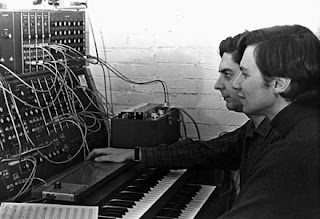
Beaver & Krause will be readily known to those who read album liner notes. 
In the late 60's any record that had a Moog on it most likely was played by either Paul Beaver or Bernie Krause.  For a quick reference play Star Collector by The Monkees and you'll have the concise Beaver & Krause play book. But where other players using the Moog were interested in either mimicking regular instruments or creating far out sounds without any restraint, B&K had a sort of organic approach. There is a warmth to their choice of timbre, which came most likely from their excursions in field recording. This is used to great effect on Walking Green Algae Blues. Sounds of animals in residence at the San Francisco Zoo are treated and used as backdrop to a slow Chicago Blues riff. I normally detest when blues riffs are used, it just seems so easy. Yet the reason why it works here is the laconic of the playing allows the nature sounds to take center place.
There is a theme prevalent to In A Wild Sanctuary; contrast and similarity. Side one is devoted to electronics. The opening track the only one with a back beat, from there on its floating music that never gets soft. A happy balance is struck between melody and sound. Stately church like hymns are wrapped in  spacey electronics. By the time side two comes in with a cheeky take on Thus Spake Zarathustra, heralding the new focus; electro acoustic sound and rhythm. The electronics work now behind a band (like that mentioned in Walking Green Algae Blues), or are abandoned all together.  There is a somewhat suspicious sounding field recording done in Peoples Park. It's just a little too clean, but if it really is a live take done on the outside then B&K's studio prowess were quite formidable.  Just about finishing up side two is a spoken word piece over a bed of proto industrial music, people saying the word war with all forms of contempt and incredulity. The final track is back to the electronics of the first side, but this time with a brief contemplative tone poem. After all, someone said war, you know those things aren't fun...

Please click on the review title for selected track: So Long As The Waters Flow

Thursday, October 9, 2008

NON • children of the black sun (Mute Corporation, 2002)


Lifting up a rock one day, I was fascinated anew to see how various forms of arachnid live so closely  huddled together...keeping cool in the feted dampness...coming home, and hearing the South of the Border ommp pah pah music obscenely bleeding through my walls, I realized that another type of collective was near...and lucky me, I didn't have to bend over to reach that rock...
So what does one do when their neighbors cultural low IQ makes it self known? Surely you just can't sit idly by...wishing to escape, and thinking of the lovely dark matter void that is space, I put on Beaver & Krause's "In A Wild Sanctuary". For as much as I love that recording, it just wasn't doing the trick. The electronic tones were way to ethereal to overcome my next door idiots...what does one do...

While standing in front of my CD collection, my minds eye brought up images of Triumph Of The Will. I had it, NON! If there was ever music for a non specific Reich, this was it. 

Most of NONs output is abrasive tape loop music, with sources coming from the most innocent of places; Girl Group records, Children records and the like. It seems that after his collaborations with Douglas P., Boyd Rice has started to get more musical. The result is a Teutonic mood music. Pick any movement that has matching uniform and architecture, and Boyd is now supplying the score. It's a locked grove take on Wagner. Slowly played instruments mixed to sonic homaging quoting the best of any opera -  the death scenes. 

After the opening tack with it's lilting harp, it becomes a showcase for heavy echo and reverb. In this sludge you have a hard time distinguishing the violins from distorted guitars, or even the marital french horns. So engrossing is this music that I can barely tell if my next door dunces are continuing their day laborers holiday...by the time Fountain of Fortune drifts in, with it's bed of treated choir loop and burning sound (or is that water?) I can barely tell...but then again, my minds a million miles away, and I'm sitting on the front porch of either a bunker or plantation...I really can't tell...but it's oh so peaceful here in the deep south of Bavaria...

Please click on the review title for selected track: Black Sun       

Wednesday, October 8, 2008

sunn 0))) • 3: Flight Of The Behemoth (Southern Lord, 2002)


Pure unmitigated nihilism...low frequency drones layered on its self, band members dressed as cartoon Heavy Metal monks. This is the Dream House over run with thoughtful knuckleheads, this is the beauty of Sunn 0)))...everything here smacks of intellectual put on. As the old saying goes, is you can't laugh at yourself, someone will do it for you. They escape the trappings of attempting to be the heaviest band on earth by taking the art route. 
Heavy Metal when striped of it's inept vocals is often not too far from drone. Perhaps there are more changes involved and it's played a little faster, but that most likely is because the musicians are coming from pop sensibilities. By now, thanks to the Internet, anyone with a little free time can track down the nearly hidden work of Charlemagne Palestine. Marry that sound to a bunch of guys who love Sabbath, Venom, St. Vitus, et al, and you have Sun 0))). Added to the assault is noise master dilettante Merzbow for remixing of two tracks.  

There is a lineage to the post rock bands of the 1990's, Jessamine or Experimental Audio Research come to mind, with the use of over amplification and artful sludge. But here the proceedings aren't as polite, and it's wrapped in cheep polyester Satan's robes.

Please click on the review title for sample track: Death Becomes You     

Monday, October 6, 2008

Alan Sorrenti • Aria (Harvest, 1972)


Haunted toy shops...most annoying of places...Jack In The Box's saying over and over again "I'm going to kill you"...the reason for this annoyance is once the logistics become clear, unless they are going to rip themselves out of the box and sprout little legs where the spring should be, nothing is going to happen...I remember this one establishment in West Virginia, I believe it was in Doddridge County. It seems the Skin Walkers infested all the inanimate objects, as they are want to do. Betsy Wetsies were heard to moan "Fuck me Daddy" to real fathers, fully embarrassed, brows damp with sweat, trying to steer their daughters past the plastic Lolita's. 

While in this store, I came face to face with a Noddy doll doing his best Arthur Brown. Shrieking away, proclaiming he was the God of Hell fire...well that's what I thought he was saying...after all he was speaking in some spirit world tongue...come to think about it, he could have been doing a mean Alan Sorrenti impersonation...

Sorrenti's first album "Aria" on initial listen could be easily dismissed as a pale Kingdom Come, or Van Der Graff Generator. You would only be partially wrong. There's no electric guitar in sight and the songs employing long form, but short of flashy playing.  The most shine given is supplied by Jean Luc-Ponty guest appearance. On the title track Sorrenti is in company to Arthur Brown's cackle and the sneer of Peter Hammil. But because Alan's voice doesn't have the full theatrics of Kingdom Come behind him, it seems almost lost in the mix. This also may be due to my not understanding of Italian. I'm sure that something dramatic is being sung. The music while not as heavy as the cover graphics suggest, does often turn on a dime, going from pastoral playing to cosmic bombast. 

The second side is broken up by relatively shorter numbers. Somehow, it's from these songs that a single was selected. I would love to hear how these were pared down to fit a 45. Like side one, everything is in a state of flux.  

As I wrote earlier that off hand he could be dismissed as a pale imitator, but that would be unkind.  There is a high strangeness factor that elevates this to note worthy. The whole album, and certainly the title track gives the feeling of a opera, but without the heavy handedness that usually happens when rock is welded to classical. 

Please click on the review title for selected track: La Mia Mente