Dr. Lovecraft

Dr. Lovecraft
Your humble host...

Monday, September 15, 2008

Richard Wright • 1943 - 2008


Define the obvious...
it's easy - and the same could be said of the reverse. Tucked between the overt and the obscure are the things that are taken for granted. Long after I'm gone, and this blog becomes one more dead URL, musicologists of all stripes will still be arguing who was the best guitar player, composer, conductor, producer, etc. But should they delve further, will they ask who was the best psychedelic keyboard player...I understand that"best" is subjective. Everyone's favorite is the best, that's why you prefer them. Yet think for a moment, who really even qualifies as a psychedelic keyboardist?...

I had to think for a while, and even then I only came up with a hand full; Sun Ra, Terry Riley, and Dave Michaels certainly were on that list, and sitting in an ever changing pecking order was Wright.

If Pink Floyd had a defining sound outside of Syd Barret's non repeatable guitar chords - then Richard Wright's keys were the perfect foil, adding texture and drone to hold it all together. After Barrett's departure, the sound of the band was moving towards a more melancholic atmosphere and Wright had come to define that sound. If anyone should ever ask you who this Wright was, please ignore the urge to play "Great Gig In The Sky", and play instead Mother Fore from the Atom Heart Mother Suite, or even the whole of Echoes. The spidery opening piano note processed through the Leslie speaker, the Stax church organ, to the pieces mournful coda, all that was him. This is not to suggest that he outshone the other band members - it's quite the contrary. Where most musicians have a disastrous habit of over playing (paging Mr. Emerson), Wright seemed to stay in the background, but all the while possessing an ability to draw attention. Leaving the listener the choice to wander in and out of the music. Later albums by Pink Floyd were less sonically adventurous but Wright's playing was still one of incredible timing and restraint.

Please click on the obituary title for selected track: Sysyphus Parts 4 and 5

10/22/08 Addendum: I had Sysyphus as the review track, but for what ever reason I am now able to upload what I had originally wanted; Love theme version 4. This is from the ill fated Pink Floyd soundtrack for Zabriski Point, and it showcases Wrights playing beautifully.

Friday, August 29, 2008

the FUGS • the FUGS (ESP-DISK, 1966)


We are a country of heathens...well, we always were...but now we have become the something worse; clucking our tongue at the sight of genitalia, and jerking off with a free hand. How did we become so joyless? Wasn't there a period of general hilarity only some 30 odd years ago?
One of those relics is the second album by The Fugs. Titled simply the FUGS the advancement from the first record is evident. Losing the Holy Modal Rounders Ed Sanders, Tuli Kupferberg and Ken Weaver were now becoming, with the aid of some ESPdisk's better side men a formidable entity, one that was not afraid to show it's collective intelligentsia coated in pure greasy teenage pimple cream. Songs about Group Gropes and Doin' Allright ("I get more pussy than a Spade") sit along the political aggression of Kill For Peace, and the gentile sadness of Morning Morning. This song shows the same direction that The Velvets would take a year later with Sunday Morning, but where Reed's poetry is based on simple street wise rhyming schemes, Sanders and Kupferberg use the meter of classical Greek poetry. Both band came from the fertile cesspool that was the Lower East Side in the 1960's. Some how even though they were locals, they couldn't have any more been from two different worlds. The Velvets being sexually ambivalent with an scoring of violence, and the Fugs goofy (with out being hippy dippy) and decidedly straight.
Lyrically a reference point that modern readers can use is the (loathsome) Bloodhound Gang. But thank God that the Fugs had a brain. One that could point out the hypocrisy of "normal" society and the lurid mind that the Counter Culture would swear they left behind.
The last track gives a glimpse at what would be the pinnacle of the Fugs recording carrier; "It crawled into my hand, honest", done for Reprise in 1968. Virgin Forrest is a Naked Lunchesque suite of seemingly random yet interconnected routines. Sound effects give way to Ovidian proclamations of sex. Before you can get worked up from the command to Aphrodite to take the penis, Tarzan breaks the mood explaining basic fucking to a noisy jungle, in appreciation come a chorus of turkey squawks. At some point the Photo Falling, Word Falling, Breakthrough In The Grey Room is quoted and the mind is clearly destroyed. In requiem delicate melody is rolled in, and logically a rousing hymn of Death Stay Thy Phantoms closes the cut up. Proving once and for all this world is hilarious, but man, it has to be taken seriously...

Fleshing out the CD reissue on Fugs Records are two live tracks recorded in 1967 and three from the aborted album for Atlantic. The live tracks are so-so and are nice to have for historic value. The same could not be said for the unreleased material, beside the reworking of Carpe Diem from the first record, and the embryonic take of Wide Wide River, is the unreleased Nameless Voices Crying For Kindness that's amazing in it's deceptiveness.
It's practically a discourse on the self, it's place in the universe, and purpose. To keep things from getting too dry, there's some references to fucking and it's all scored to a Doors back beat...Socrates enters the Hollywood Bowl stage, behind him the band, dressed in paisley togas tune up...he leans over the lip of the stage zeroing in on a honeydew of a teenybopper asking the nubile girl seated in the front row "How are ya? Where'd yah go to skewll? Do you know where the seat of man's soul is located ?" She faints dead away, her mind and pussy wet...both moist with ideas and possibilities...

Please click on the review title for selected track: Kill For Peace

Monday, August 18, 2008

Created by Bruce Haack • The Electric Lucifer (Columbia, 1970)


There are some holly grails a mere mention will send an obsessive nut packing his bag, to mythic plateaus where it's said in hushed whisper there are man eating trees. Or under the ground, looking for tombs, only to be rewarded with finding a room strewn with junk and artifact alike. Such is the makeup of this doctor, but my objects are to be found not in the Artic deserts but flea markets, combing through crates that smell of stale basement and forgotten purchases.
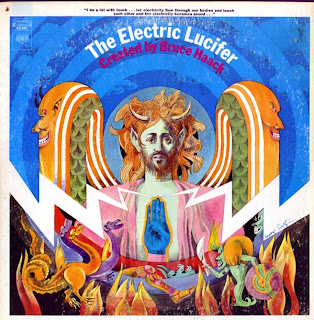
It was at a then local flea market where under the broiling summer heat of 1988 I stumbled across this oddity. Sandwiched between Boston Pops and Eagles records was this Milton Glaser like cover. It showed Jesus as green skinned Imp, his sides flanked by mock demons. The title alone was worth more than a passing curiosity: The Electric Lucifer"...At that point of the late 80's most older people were tossing out the contents of their youth. Beside the endless stream of CSN&Y, Derrick and the Dominoes and the like, Switched On style records were showing up. I had been burned enough times that I was getting wary of records that featured the Moog. Checking the back cover and it's nearly impenetrable liner notes, I discovered no cover songs. Good sign number 1. From what I could make out from the liner notes, the album was attempting to paint Lucifer as his first incarnation - The Light Bearer. Fortuitous omen number 2.
The tipping factor? It was a white label promo cover, with boxes suggesting to DJ's what tracks to play...and none of them has been checked...
As I wrote earlier, I'm not a fan of Switched On LP's. For the most part they become a listening affair punctuated with observations along the lines of "Look! The lead line in Winchester Cathedral is being played with multi timbre", or "so that's not a bass"? I prefer electronic records where something new is being tried, and that's exactly what I got.
Straight off the bat with the first cut of the album opens with this carnival spook house song, clownishly cavorting in. The singing voice vocodered to almost unrecognizably. Images of Betty Boop trapped in a haunted Bakelite radio, besieged by demonic cathodes.
From here the LP straddles the fence of serious electronics and a children's record. Infectious melodies are broken up by blasts of heavy echo and sine waves. And why wouldn't this all sound like a Freak Out for the Sesame Street set? Unknown to me at the time, Haack made a living doing children's records. Years later those LP's were reissued and they have the same quality as Electric Lucifer. The main message is think for your self, rebel from constraints, do your own thing. All the things Anton LeVey suggested, even with the same Sunday Funnies take on the Horned One.
My then room mate (I have mentioned him before, he's the one who got the hot foot while sleeping) came in to my room wide eyed and smiling. "What is this"?! It fell out of the realm of what I knew, I didn't know. At that point in history, ESPdisk sides while somewhat obscure were pretty easy to obtain, and concurrently Nonesuch electronic records had elements of adopting some rock music but never came close to this. This was pop music for a brightly colored Will To Power future. The room mate and I marveled at the cover with it's promo slick, could this really have been released on a major label?
As the LP played on, a uncredited male voice doing his best Jim Morrison psychedelic croon, adding another layer of accessibility. I guess Satan was really trying his best to convert the teeny boppers...
Like most records of the late 60's and early 70's, the Vietnam war had to be addressed. Used as a template for art, here it's simply called "War". Perhaps the heaviest track, it starts as a break neck Walter Carlos fugue, and then for further comedic affect the focus shifts to a lopsided military march, punctuated with machine gun fire. Eventually the Musique Concret is stopped short. A child intones "I don't wanna play any more", then fades out as a mournful dirge / lullaby.
Even with the Switched on Bach move used in the above track, there really isn't any reference point for what your hearing. Just like Trout Mask Replica is of it's time but from an alternate universe, Electric Lucifer has that same feel. At one point a track called Super Nova condenses A Rainbow In Curved Air to five minutes, but even then it seems like it's coming from left field.

With such an auspicious introduction to the mainstream what could follow? Haack had already been a guest on quiz shows, debuting his latest home made Synths that plays a persons electro magnetic aura to the delight of the studio audiences. He'd composed pop songs for Theresa Brewer, did music for commercials, and incidental music for theater. The world with it's newly turned on ears would fall at his feet...no...he sunk back into undeserved obscurity.

Bruce died in 1988 (ironically the year I found this, one of my favorite records). In between the year of The Electric Lucifer and his death, to pay the bills he made more children's records, along with two more parts to Electric Lucifer. The history is a little sketchy as to where the second part (called Book Two) released posthumously a few years back falls. There seems to have been two Book Two.
By now, the children's records have a harsher edge to them, and the Book Two is down right bitter and angry. The cartoon music is still the bedrock, but the words are now from the point of a leering Pit Boss.
And perhaps rightfully so...Reagan and Bush I were invoking the other end of the dark forces; strength without a hint of compassion. Children's minds in school were not being engaged, but merely numbed with repetition. The smart ones to the office, the dumb ones to the front lines, and the odd? Marginalized...

The Omni Group has reissued Electric Lucifer with a alternate tale of the opening track, and half hour interview with Haack on Canadian Radio promoting the LP. Here he goes on at length for his love for rock music, especially The Beatles and The Moody Blues.
Do your mind and soul a favor and go by this CD. Perhaps it'll remind you of a time when evil meant just rebellion, and good was not an excuse for a totalitarian movement.

Please click on the review title for selected track: Program Me

Tuesday, August 12, 2008

Sun Ra And His Solararkestra • Other Planes Of There (Saturn, 1965, 1966, or 1967)


Is that the past I am viewing from the spaceships porthole? The inhabitants of the planet we have landed on are upright crab-men. Clothed in Neanderthal loin cloths, they are armed with laser shooting spears...you'll forgive me, I was looking through some old photos I had taken...wonderful times the 1990's...
There are places in the galaxy where the primitive and modern rest side by side. How often have I heard the drunken party guest mutter "Ape with a microwave", only to be reassured by the host that it was just a general observation. I shouldn't take it personally...
Sun Ra understood these contradictions. Listening to the title track of Other Planes of There ones ear has to quickly reassemble it's inner calendar. While the album as a whole is a study in contrast, it's the opening that embodies the concept.
Opening with a blast of dark chords , not unlike modern 20Th century classical, quickly it shifts to lopsided jazz consisting of sharp piano chords and reeds. Meandering in this mode for a while we are gradually taken to some sort of ancient Melody. Oboe painting a picture of the Serengeti. Not content to stay too long there, Ra's piano starts rumbling low end notes bringing us back to modern times. Content to shift from focus to focus, like most Ra compositions it ends when he's run out of notes.
Side two uses the same floor plan, only breaking the focus up into separate pieces. Quietly skittering in on sparse snare drums, tapping out a rhythm that seems more like a lead line, Sound Spectra/Spec Sket is then married to hunting call horns bathed in reverb. From there the maelstrom of side one resumes.
Next comes the tack Sketch. Duping the listener with what would seem like a normal swing style played by the piano, it's John Gilmore's sax that ups the oddball factor. What is the more Fortian moment here? The presentation of swing as a primitive movement, or Gilmore solo that sounds like he's playing along to a radio broadcast heard through the wall of the next room? The sonic slight of hand is the reverb. Used a cloaking device, it starts to muddy the sax to the point where the treatment becomes an instrument in it's self. Then jarringly shut off, the sax appears almost out of nowhere.
Sandwiched between the Sketch and the mammoth album closer Spiral Galaxy, is the aptly titled Pleasure. Languidly drifting in a sea of bowed bass and light piano, we are given another example of a sax solo that plays around the tune rather than join in.
By albums end, Spiral Galaxy show us that the tempo of the Heavens can be marked in 3/4 time. An ancient sounding military precision is kept here, framing a fussy sounding woodwind section - not unlike a tornado visible on the horizon. Jabs of shrill oboe crackling over piano.
Reverb is heavily placed on the woodwind segments, only to be quickly withdrawn for the other instruments to come through. All the while the 3/4 is being kept, but with small additional beats, shifting the focus. Just as it seems that it's winding down, some new squall of sound arises and your off again. Eventually it does end, but not in grotesque crescendo but with the tapping of some percussion. You've arrived safely back to the present time. Ra and Arkestra have taken you through various time shifts, and you barely moved an inch.
Like most Sun Ra recordings, it's a little hard to pin down the where and whens. While this session was recorded in 1964/65, it may not have seen print until 1966, or 1967. By then Ra had moved the Arkestra further in to space, employing the Moog as his main instrument. So a piano based record seems even further antiquated.

Please click on the review title for selected track: Sound Spectra / Spec Sket

Thursday, July 31, 2008

The Advancement • The Advancement (Philips, 1969)


The Doctor is sick...not only a fine book by Anthony Burgess, but a personal observation...remember faithful readers; if it's hot outside, eating pushcart chicken might not be such a good idea.....
So here I am, cooped up at home with not much to do. No way am I venturing out to see any colleges or patients. Then what better way to pass the time, then wax poetic about this fantastic LP...
The Advancement were the cream of two combs; Lou Kabok and Hal Gordon from Garbo Szabos band, and Lynn Blessing from Bill Plummers Cosmic Brotherhood. Rounding out the Advancement are a a few other players of note: Colin Bailey, Richie Thompson, Art Johnson, and David Kinzie. These members are a sort of B Wrecking Crew.
Jazz in the mid to late 60's was akin to a rudderless ship. There was no clear idea as where to go. The rock crowd was now accepting of longer song form. Odd meters and noise had been appropriated. What once seemed musically non conformist was now coming out of the tiny speakers of any teenager's stereo. But like any American art movement it did what it did best...amalgamate...
Beatles covers would sit next to reworking of Bop standards with new names. Records were packaged in the latest colors. Whole Jazz departments at major record labels were saved by having photos of the band members wearing Nehru Jackets...Predictably the results were often awful. Note for note readings of Robbie Krieger guitar solos, drained of all their inventiveness, were tacked onto the umpteenth reading of Light My Fire...but every once in a while something like The Advancement would come out. For something that was released in the dark days of 60's Jazz, there isn't a cover tune on the whole LP. At most, two tracks come a little too close to plagiarism; Fall Out is practically a Doors track, only without Morrison belching his way through the vocals. The other, Hobo Express, is reworking of Van Dyke Parks reading of Donovan's Colors.
Elsewhere on the LP the mood is generally laid back, and would not sound out of place in a Hollywood psychedelic movie. The opening track "Juliet", brought to mind immediately AIP's The Dunwitch Horror. It's wistful air undercut with melancholy... and in counter balance, Stone Folk is a sort of hip Gregorian chant, The guitar solo panned from speaker to speaker.
The playing is nimble throughout. Everyone is in their element. No embarrassing moments of playing the new sound without understanding it.
Fallout has added this to their continuing list of excellent reissues. Once again, it's another recording taken from an LP, but the sound is clear. Kudos also to them for taking care in packaging the music with it's moody cover intact.

Please click on the review title for selected track: Stone Folk

Tuesday, July 22, 2008

Cosmic Eye • Dream Sequence (EMI, 1972)


I remember once, when I was a young intern, after a night of chemical studies that I had stayed up so late that I saw the sun rise. Realizing that it was way past my bedtime, I bid my fellow students (ironically) a good evening and drifted home. After arriving home, I climbed the stairs and went to bed at 8 o' clock. A few minutes later my eyes popped open I saw that the clock hands had barely moved a inch...what a disappointment, my blasted insomnia had returned, and here I was in a false state of being awake. All I wanted was some rest. There the morning sun crept in the sky, another Summer day about to begin...and then it hit me, it wasn't 8:15 AM, but PM...I had slept twelve hours, and it only felt like five minutes...
Cosmic Eye's album has that same affect. I had somehow found this album, or at least a track, on line. This persons blog was full of Bollywood and Sitarpoitation tracks. For the life of me I can't recall how I got there. As I heard Sequence 9, I was struck how similar it was to George Harrison's Wonderwall Soundtrack. It was from that likeness, that I had conjectured the music had to be from the 60's.
As luck would have it, I found a CD of the album at Kim's St. Marks. Not too cheaply I might add, but that one track with it's running time of under two minutes was so intriguing. Like I had said, it reminded me of Wonderwall, with it's juxtapositions of jazz and Indian music.
Playing it immediately when I got home, the music was so intense I could do nothing else. I was listening to music that was in collage form, a melancholic Procol Harum like tune would give way to a restrained free jazz work out, from there that in turn that blended a spy music like theme with traditional Sitar music...How is it other Psych-Heads have not raved about this? And then I looked at the copyright date, disbelieving my eyes...it read 1972...that explained it all. Most Psych fans are forgiving of of certain musical styles coming from other countries at later dates, but not England. If this came from Germany, or even France lets say, high praise would be heaped on it. But it hails from England, when Sitars , flanging, and artistically treated echo, were well past their hip sell by date.
It seems that this album was the brain child of one Alan D'Silva. He was noted for playing jazz in a raga style, but much later than Garbor Szabo. D'Silvas first album is from 1969, and he recorded up until his death in 1976. Yet I cant help but think this was perhaps his first recorded work. In 1969 this would still sound relatively fresh, but by 1972, very much like yesterdays papers.
There's very little information about D'Silva online. I was able to find a pitifully uninformative web site run by his family. They mention there the CD issue, and it being a bootleg of poor quality. I've listened to this CD numerous times, and found nothing wrong with the sound. Unlike most legitimate reissues where you can tell the music was remastered from a vinyl copy, here everything is surprisingly clear. I'm not sure how easy it will be to get this CD, but it's well worth hunting down.

Please click on the review title for selected track: 4

Sunday, July 20, 2008

Kawabata Makoto • Jellyfish Rising (Funfundvierzig, 2005)


Just as much as the lateness of the hour affects what I decide to listen to (The Madcap Laughs seems awkward at 3:00 pm, but brilliant at 12:30 am), weather can also play a part. Temperature rises and out goes the Minimalism, or anything with too many notes...so, what to play when everything is a bother? Somehow Jellyfish Rising is an amalgamation of those two styles and fits perfectly.
Here Makoto is in full Gamelan music mode. Shifting tones from the guitar cascade over repetitive figures. It never really goes anywhere, but there is a feeling of sonic rushing around. Think of this as a more gentile version of The Monkey Chant, and you'll have a beginning.
On the occasions I was subjected to The Grateful Dead, or read various band members name dropping composers, I could never figure out what the big deal was. I'm sure Garcia must have had a voracious ear, but it never seemed to inform his fingers. And with Kawabata, it's the complete opposite. He wears his influence on his sleeve. When he's not destroying his guitar a'la numerous guitar Gods, or thumbing his nose at sainted rock albums with Acid Mother's Temple, there is a serious side that comes out. It's in these albums where he shines brightest. Yes, he's playing here like Steven Reich filtered through Jerry Garcia, and the cover is a hideous throw back to New Age album graphics, but the playing so beautifully becomes a oxymoron - simple complexity. The two tracks on the CD never get mired in flashy playing. It's all pulsing and flanging, no real guitar solos. Repetition is the key here, and it's in that you find yourself with room to think. Where albums like this tend to get bland in their desire to be cosmic or even worse, soothing, here there is no down side.

Please click on the review title for selected track: Astral Aurelia Aurita Laavarek

Monday, July 7, 2008

The Alan Lorber Orchestra • The Lotus Palace (Verve, 1967)


A fellow Doctor once passed along some sagely advice: "Set and setting", and this afternoon I found myself in full experience. July is in full swing, the streets are hot but thankfully humidity free, reminding me of old Calcutta. Everywhere you look people are coping with the heat, free from the indignity of sweat stains. It is in this environment I find my self listening to The Lotus Palace. Just a few days before, I was in Springfield MA, surrounded by trees, and for some reason the music didn't fit. I'm not exactly sure why, but the glass and concrete buildings were a perfect visual accompaniment.
Is it because the music that Lorber is presenting reeks of the sophisticated? True he's playing what was the hits of the day, filtered through sitars and Indonesian percussion...you haven't lived until you've heard Up Up And Away done with sitars.
I've never been able to figure out why, but every production by Alan Lorber has this muddy quality. Most of his recorded work is in stereo, but you would be hard pressed to tell. From the varied productions that I have had, everything has that sort of near bootleg recording quality. Was he reusing tape, or bouncing too many tracks? Either way it's the sonic thickness that adds to the charm. Where most producers raise the EQ on tambouras to the point where the drone is bone shattering, he'll make them so muffled that they caress the ear.
The choice of covers among his originals are interesting. Tim Harding's Hang On To A Dream, along with Flute Thing by The Blues Project sit next to a couple of Beatles numbers. As you most likely know, the Beatles were too idiosyncratic to lend to covering, and here Lorber bravely takes on two of the more difficult songs; Lucy In The Sky With Diamonds, and Within You Without You. It's on the second that he succeeds. Nearly covering the song note for note, it sounds more like a backing track than a hip cash in.
Lorber's originals are in the vein of Aloha Lounge background music, Martin Denny's Mai Tai spiked with STP. Tremolo, heavy reverb...all forms of audio psychedelia are used, stopping short of backwards tape and flanging. Don't want to freak out the Lounge Lizards too much.
The Big Beat reissue (long out of print) includes 3 bonus tracks. The third is a track that would appear to be a pared down take of Purple, from Bobby Calenders LP, here it's called "I Heard The Rain And..." hearing it without Bobby's serpentine vocals, you really get the idea that he was just making the lyrics up on the spot.

Please click on the review title for selected track: Echo Of The Night

Sunday, July 6, 2008

Samurai • Samurai (Greenwich, 1971)


In light of the two previous posts, I felt that I had better write about music, lest this becomes an obituary column.
Is there anything more despicable than Jazz Rock? Perhaps Adult Contemporary Western, but for me it's the later that somehow gets under my skin like a case of chem trail Morgellos. These days I find myself listening to bands that insist on using poly rhythms without a clear understanding of how. The results can either be brilliant, like the Hampton Grease Band, or unpleasant like The Web. It is from The Web's demise that Samurai formed. Shone of their terrible vocalist who must have had aspirations to be the next Engelbert Humperdink, the band adopted a Steely Dan / Hot Rats approach. While they don't get anywhere near the complexity of that type playing, the lack of break neck smarty pants musicianship becomes all the more rewarding.
Arrangements are allowed to breathe. The songs don't seemed composed to a state of still born. Best of all, just two tracks break the above five minute barrier. Most bands when they have a lengthy track, seem to forget how to end it. There's usually the pattern of funny time signature, followed by an amateurishly insightful lyric framing solos of epic proportions. Proving that just because you had taken music lessons, that everyone understands how a composition works. It's here that Samurai excel. having come from a pop band aggregation, the idea of song craft is up front. For all of their Prog leanings, you can actually hum a few tunes.
Esoteric Recordings have reissued this, their sole LP, along with the three previous recordings as The Web. Reading in the liner notes that the original vocalist left after the second Web LP, I may at some point buy it. I'd say avoid the first LP, based from the second LP. Yes, his voice is that bad...

Please click on the review title for selected track: Saving It Up For So Long

Monday, June 23, 2008

George Carlin • 1937 - 2008


...and the hits just keep on coming...I was a fan of George Carlin as a young Doctor in my formative years of record collecting. His work, stood up to repeated listening unlike say Cheech and Chong, or even Steve Martin. Where with the aforementioned others it was stoned humor that merely accentuated the state you were in before the record went on, or just a vanity project, Carlin's records were like reading a eye opening Philosophy lesson. Where Hegel or Kant were not known for their humor, and Sartre is the death of any party, he told the truth (granted from a crabby perspective) and was just witty enough to get it under your skin. There it would fester like a alien virus, eating out the lies and crap that lived in the cerebellum. Yes, there were lapses in judgment, Bill and Ted's Excellent Adventure, and a short lived sitcom on Fox in the early 90's come readily to mind, but at no point did he ever soften. I couldn't help but think that what you saw was what you got. Salute...