
Dr. Lovecraft

Dr. Lovecraft
Your humble host...

Sunday, October 12, 2008

Beaver & Krause • In A Wild Sanctuary (Warner Brothers, 1970)


It's a quiet Sunday. Outside the air is occasionally punctured by the cries of a child playing...odd though, no one else seems to be joining in...I'm reading the paper online, amazed how long the Presidential  campaign has lasted...it seems so 2007...and while this day lazily moves from one side of the sky to the other, playing in the background is Beaver & Krause's In A Wild Sanctuary.  This is what I was attempting to listen to when the next door neighbors went about their dally routine...I guess on Sunday they play pretend behave for the Lord.

Beaver & Krause will be readily known to those who read album liner notes. 
In the late 60's any record that had a Moog on it most likely was played by either Paul Beaver or Bernie Krause.  For a quick reference play Star Collector by The Monkees and you'll have the concise Beaver & Krause play book. But where other players using the Moog were interested in either mimicking regular instruments or creating far out sounds without any restraint, B&K had a sort of organic approach. There is a warmth to their choice of timbre, which came most likely from their excursions in field recording. This is used to great effect on Walking Green Algae Blues. Sounds of animals in residence at the San Francisco Zoo are treated and used as backdrop to a slow Chicago Blues riff. I normally detest when blues riffs are used, it just seems so easy. Yet the reason why it works here is the laconic of the playing allows the nature sounds to take center place.
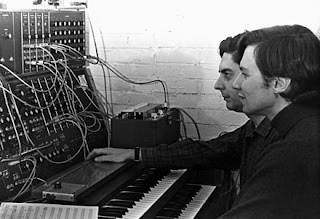
There is a theme prevalent to In A Wild Sanctuary; contrast and similarity. Side one is devoted to electronics. The opening track the only one with a back beat, from there on its floating music that never gets soft. A happy balance is struck between melody and sound. Stately church like hymns are wrapped in  spacey electronics. By the time side two comes in with a cheeky take on Thus Spake Zarathustra, heralding the new focus; electro acoustic sound and rhythm. The electronics work now behind a band (like that mentioned in Walking Green Algae Blues), or are abandoned all together.  There is a somewhat suspicious sounding field recording done in Peoples Park. It's just a little too clean, but if it really is a live take done on the outside then B&K's studio prowess were quite formidable.  Just about finishing up side two is a spoken word piece over a bed of proto industrial music, people saying the word war with all forms of contempt and incredulity. The final track is back to the electronics of the first side, but this time with a brief contemplative tone poem. After all, someone said war, you know those things aren't fun...

Please click on the review title for selected track: So Long As The Waters Flow

Thursday, October 9, 2008

NON • children of the black sun (Mute Corporation, 2002)


Lifting up a rock one day, I was fascinated anew to see how various forms of arachnid live so closely  huddled together...keeping cool in the feted dampness...coming home, and hearing the South of the Border ommp pah pah music obscenely bleeding through my walls, I realized that another type of collective was near...and lucky me, I didn't have to bend over to reach that rock...
So what does one do when their neighbors cultural low IQ makes it self known? Surely you just can't sit idly by...wishing to escape, and thinking of the lovely dark matter void that is space, I put on Beaver & Krause's "In A Wild Sanctuary". For as much as I love that recording, it just wasn't doing the trick. The electronic tones were way to ethereal to overcome my next door idiots...what does one do...

While standing in front of my CD collection, my minds eye brought up images of Triumph Of The Will. I had it, NON! If there was ever music for a non specific Reich, this was it. 

Most of NONs output is abrasive tape loop music, with sources coming from the most innocent of places; Girl Group records, Children records and the like. It seems that after his collaborations with Douglas P., Boyd Rice has started to get more musical. The result is a Teutonic mood music. Pick any movement that has matching uniform and architecture, and Boyd is now supplying the score. It's a locked grove take on Wagner. Slowly played instruments mixed to sonic homaging quoting the best of any opera -  the death scenes. 

After the opening tack with it's lilting harp, it becomes a showcase for heavy echo and reverb. In this sludge you have a hard time distinguishing the violins from distorted guitars, or even the marital french horns. So engrossing is this music that I can barely tell if my next door dunces are continuing their day laborers holiday...by the time Fountain of Fortune drifts in, with it's bed of treated choir loop and burning sound (or is that water?) I can barely tell...but then again, my minds a million miles away, and I'm sitting on the front porch of either a bunker or plantation...I really can't tell...but it's oh so peaceful here in the deep south of Bavaria...

Please click on the review title for selected track: Black Sun       

Wednesday, October 8, 2008

sunn 0))) • 3: Flight Of The Behemoth (Southern Lord, 2002)


Pure unmitigated nihilism...low frequency drones layered on its self, band members dressed as cartoon Heavy Metal monks. This is the Dream House over run with thoughtful knuckleheads, this is the beauty of Sunn 0)))...everything here smacks of intellectual put on. As the old saying goes, is you can't laugh at yourself, someone will do it for you. They escape the trappings of attempting to be the heaviest band on earth by taking the art route. 
Heavy Metal when striped of it's inept vocals is often not too far from drone. Perhaps there are more changes involved and it's played a little faster, but that most likely is because the musicians are coming from pop sensibilities. By now, thanks to the Internet, anyone with a little free time can track down the nearly hidden work of Charlemagne Palestine. Marry that sound to a bunch of guys who love Sabbath, Venom, St. Vitus, et al, and you have Sun 0))). Added to the assault is noise master dilettante Merzbow for remixing of two tracks.  

There is a lineage to the post rock bands of the 1990's, Jessamine or Experimental Audio Research come to mind, with the use of over amplification and artful sludge. But here the proceedings aren't as polite, and it's wrapped in cheep polyester Satan's robes.

Please click on the review title for sample track: Death Becomes You     

Monday, October 6, 2008

Alan Sorrenti • Aria (Harvest, 1972)


Haunted toy shops...most annoying of places...Jack In The Box's saying over and over again "I'm going to kill you"...the reason for this annoyance is once the logistics become clear, unless they are going to rip themselves out of the box and sprout little legs where the spring should be, nothing is going to happen...I remember this one establishment in West Virginia, I believe it was in Doddridge County. It seems the Skin Walkers infested all the inanimate objects, as they are want to do. Betsy Wetsies were heard to moan "Fuck me Daddy" to real fathers, fully embarrassed, brows damp with sweat, trying to steer their daughters past the plastic Lolita's. 

While in this store, I came face to face with a Noddy doll doing his best Arthur Brown. Shrieking away, proclaiming he was the God of Hell fire...well that's what I thought he was saying...after all he was speaking in some spirit world tongue...come to think about it, he could have been doing a mean Alan Sorrenti impersonation...

Sorrenti's first album "Aria" on initial listen could be easily dismissed as a pale Kingdom Come, or Van Der Graff Generator. You would only be partially wrong. There's no electric guitar in sight and the songs employing long form, but short of flashy playing.  The most shine given is supplied by Jean Luc-Ponty guest appearance. On the title track Sorrenti is in company to Arthur Brown's cackle and the sneer of Peter Hammil. But because Alan's voice doesn't have the full theatrics of Kingdom Come behind him, it seems almost lost in the mix. This also may be due to my not understanding of Italian. I'm sure that something dramatic is being sung. The music while not as heavy as the cover graphics suggest, does often turn on a dime, going from pastoral playing to cosmic bombast. 

The second side is broken up by relatively shorter numbers. Somehow, it's from these songs that a single was selected. I would love to hear how these were pared down to fit a 45. Like side one, everything is in a state of flux.  

As I wrote earlier that off hand he could be dismissed as a pale imitator, but that would be unkind.  There is a high strangeness factor that elevates this to note worthy. The whole album, and certainly the title track gives the feeling of a opera, but without the heavy handedness that usually happens when rock is welded to classical. 

Please click on the review title for selected track: La Mia Mente


Wednesday, October 1, 2008

Dead Can Dance • The Serpent's Egg (4AD, 1988)


What to do, what to do...a man with free time is a dangerous thing...all sorts of odd notions can be acted upon...using this (regretfully) open time, I found my self at http://www.marsanomalyresearch.com/

Fascinating read,that website. It amazes me how stupid humanities mind can be...the evidence is there...but then again, if the United States is unlucky, we'll pretty soon have our first woman President convincing us that the earth is only six thousand years old...

So with a mind full of mysteries, my tastes this afternoon brought me to the Dead Can Dance's masterpiece; The Serpent's Egg. In the history of Goth Rock, nothing sounded like this. Where other bands attempted to emulate the sound of non specific eon old rituals using cheesy synths and drum machines (I don't recall hearing Roland 800's during the wild hunt), the DCD perfectly invoke the mood. Perhaps it is by this point they were using strings and brass, and more importantly, the compositional talent to not be a 101 String Orchestra version of Joy Division. Where most 4AD and alike bands thought that playing in a minor key was all you needed to sound heavy, the DCD had scope to draw on Popol Vuh and Ennio Morricone.
The air of catharsis hangs heavily on the album. You are always somewhere between dawn and dusk. Either the funeral has begun, or the corpse has come home to comfort the aggrieved. This state is the most exquisite of horrors. Thinking back to the Mars Anomalies site it is just a mater of time before people get the idea that something is happening up there, that there is life on Mars. What will happen when everyone figures this out? Will there be planet wide panic since God has lied and there were others beside us, or resolution. The pressure is off since we're not that special after all...

Please click on the review title for selected track: Severance

Tuesday, September 30, 2008

Moondog • Moondog and his Friends (Epic, 1953)


The Doctor is free...for the moment...and what a wonderful opportunity to wax poetic on one of New York's transient sons; Moondog. 
   Standing on the corner of 54th and 6th avenue dressed in Viking regalia, he was the oddballs oddball. An imposing blind standing with spear in hand as if to refute the 1950's workaday world. He lived on the streets for 20 of his 30 years spent in New York, but Moondog was just more than a visual oddity, he was a street musician of incredible compositional skills. Playing percussion on home made instruments, he welded the Native American drumming he heard as a child with European rounds creating something fresh.
   La Monte Young is often credited with being the father of minimalism, if that's the case then Moondog was the milkman. Both Phillip Glass and Steven Reich have sited him as a direct influence and it shows. The intricate percussion pieces of Right and Glass's repetitive keyboard figures are far close to Moondog than Young's one long note approach, yet Moondog was against minimalism.
   Recording as early as 1943 on his own private label, by 1953 he had come to release his first mainstream recording: Moondog and his Friends". At this point he was beyond a mere only in New York entity, but a well respected composer, who just happened to like living on his own terms.  The "and Friends" Lp showcases both sides of Moondog, the percussive workouts and rounds, interspersed with philosophy lessons. While on side two points to future compositions; Suites for classical strings with a underscoring of rhythmic klip klop drumming. All the while keeping things short. Rarely does a composition of his break the 10 minute mark, keeping the classical rooted in pop.
  
Please click on the review title for selected track: Suite no. 2 - First Movement in 7/4

Tuesday, September 23, 2008

Terry Riley • Persian Surgery Dervishes (Shanti, 1972)


There are some stars that while invisible to the naked eye, pull strings of influence still. The Dogon tribesmen for centuries swear by the (somewhat faulty) information that the Space Ark Captain Nommo gave them, and keep their hopes of a celestial world beyond this unwavering. Other stars blaze brightly in the night sky then for all it's intensity burn out, leaving vague memories, and radioactivity as a calling card. Terry Riley by the early 1970's had reached the height of his above ground carrier. He was name checked by Pete Townsend in the song Baba O' Riley, and used in it's opening bars a truncated Rainbow In Curved Air. The Soft Machine were starting to adopt the same Rainbow style of playing, and the majority of Krautrock was certainly an off spring. Perhaps Riley's popularity could be that he's the only Minimalist that understands the need for a middle eight...
   By the time the Persian Surgery Dervishes appeared in 1972 he was just about to pull the plug on his popularity, and go to India to study. Nothing he would do afterward would sound so thick or funky. Over two LP sides taken from two live performances a year apart the piece moves from musical mode to mode. One moment it's Middle Ages fugue like, slipping in bits of R & B slight of hand, only to give way to rapid fire cascades of pure Minimalism filtered through raga. The real time tape loop pulses in a way that points to a future musical style that (regretfully) he has been tied to, Techno... 
   What makes the first performance so amazing is the use of an emotion that is rarely if ever evident in Riley's work, that of menace. There is a determined presence in the playing that was foreshadowed on The Church Of Anthrax record obvious here. The endless cascading of notes never gives one time for rest, I can not stress the cold menace here. If techno is to far a stretch for you too grasp, then the next comparison would be John Carpenter, only played much better.
    Record two presents a more textured reading of the piece. Using the style of an evening raga, there is funerary air to it. Here the piece wanders, the same melody sections are used, but this time it seems that Riley is choosing what comes next.  Quiet contemplation arises between the long drawn out organ tones. The tape loop even seems to have less notes. 

   Released on the tiny label Shanti in France, this was never an easy record to find. After the first pressing, the Shanti gallery had a flood and the master tapes were damaged, resulting in no reprints. In the early 1990's a CD issue came out from Italy. This was taken from a well worn copy, with the usual pops and clicks of vinyl. Normally I wouldn't mind. There is a warmth to vinyl that CD's just haven't gotten down yet. The real shame here is the mastering. Everything is muddy. Not having heard the original, it's had to say if that's from the Shanti issue. I'm also not too sure how much I believe the lost tapes story. A few years back Sun Ra had his record from Shanti reissued and they sounded fine.
   All the sound issues aside, it's good to have this document still around showing the depth and mastery of Terry Riley before he imploded back to willed obscurity.

Please click on the review title for selected track: Persian Surgery Dervishes (performance one, part one)

Thursday, September 18, 2008

Nurse With Wound / Organum • A Missing Sense / Rasa (United Dairies, 1985)


"Music to clear a room by" is how a colleague once put it. This is coming from he who is a proud owner of that record which has a rotoscoped demon baby on it's cover...Black Sabbath, ugh...and with Dio no less...


To go into the ever growing history of Nurse With Wound would be an act of futility. Organum presents the same challenge. Both are less bands than artists embracing the tenet Pop Art; brand name over identity. Nurse With Wound is really Steven Stapleton, and respectively Organum is David Jackman.

Side one is perhaps the only cover that I know of anything by Robert Ashley. Using Automatic Writing as it's base (the mumbled words, quiet organ tones), Stapleton then adds the typical NWW sound on top; abrasive scrapings, bursts of white noise, low tuba notes, and all manor of studio trickery. This piece was originally a private tape Stapleton made for himself to listen to while tripping. Automatic Writing was the only other music he could listen to in that state without feeling paranoid.
A Missing Sense has that late night feeling where ambient sounds are amplified once they are no longer competing for space. A dog barking in the distance has more dramatic implications once the din of cars, cell phone conversations, or even just the low level hum of daytime activity ceases. The listening instructions are that the piece is to be played at a very low volume. In comparison, but clearly from another dimension, Brain Eno's Discreet Music has the same request. But where Eno has you watching the afternoon drift along, A Missing Sense is not unlike that state of paranoia that Stapleton wished to escape from. Voices that are barely legible seem to come from all sides. The air is never calm, little cells of events erupt without any resolution. It's as if the negative space around us has been reviled to be full activity, unknown to the naked ear.

Organum's Rasa fills all of side two, having heaviness of a Tibetan ritual. Long drones, some sort of metallic clanging, and a whispered vocalise come at you immediately. There is no buildup here, all sense of western musical notion is dispelled. The moment the piece starts, it's all various drones; some drones are shorter, some longer. The metallics play what would be considered a solo, but even then the notion of a pre determined random even to have a conclusion must be dispersed. If this description sounds very La Monte Young, it's because it does. There is some aahhhhing in the background that comes close to Drift Study, you would think there is a sampling of the Shandar record going on.

Like almost all early Nurse With Wound releases at some point in the 1990's they were reconfigured. Some long out of print record had a few of it's tracks placed next to something also from a long out of print record and this configuration was given a new name. When A Missing Sense was reissued, the Organam piece was gone, but you got two other NWW rarities in it's place. Roughly about the same time, Jackman had started to reissue compilations (getting as far as volume two) that worked on the completion through obscurity theory. Rasa, uncredited as to it's original source was placed on Volume One.

Please click on the review title for selected track: Rasa 

Monday, September 15, 2008

Richard Wright • 1943 - 2008


Define the obvious...
it's easy - and the same could be said of the reverse. Tucked between the overt and the obscure are the things that are taken for granted. Long after I'm gone, and this blog becomes one more dead URL, musicologists of all stripes will still be arguing who was the best guitar player, composer, conductor, producer, etc. But should they delve further, will they ask who was the best psychedelic keyboard player...I understand that"best" is subjective. Everyone's favorite is the best, that's why you prefer them. Yet think for a moment, who really even qualifies as a psychedelic keyboardist?...

I had to think for a while, and even then I only came up with a hand full; Sun Ra, Terry Riley, and Dave Michaels certainly were on that list, and sitting in an ever changing pecking order was Wright.

If Pink Floyd had a defining sound outside of Syd Barret's non repeatable guitar chords - then Richard Wright's keys were the perfect foil, adding texture and drone to hold it all together. After Barrett's departure, the sound of the band was moving towards a more melancholic atmosphere and Wright had come to define that sound. If anyone should ever ask you who this Wright was, please ignore the urge to play "Great Gig In The Sky", and play instead Mother Fore from the Atom Heart Mother Suite, or even the whole of Echoes. The spidery opening piano note processed through the Leslie speaker, the Stax church organ, to the pieces mournful coda, all that was him. This is not to suggest that he outshone the other band members - it's quite the contrary. Where most musicians have a disastrous habit of over playing (paging Mr. Emerson), Wright seemed to stay in the background, but all the while possessing an ability to draw attention. Leaving the listener the choice to wander in and out of the music. Later albums by Pink Floyd were less sonically adventurous but Wright's playing was still one of incredible timing and restraint.

Please click on the obituary title for selected track: Sysyphus Parts 4 and 5

10/22/08 Addendum: I had Sysyphus as the review track, but for what ever reason I am now able to upload what I had originally wanted; Love theme version 4. This is from the ill fated Pink Floyd soundtrack for Zabriski Point, and it showcases Wrights playing beautifully.

Friday, August 29, 2008

the FUGS • the FUGS (ESP-DISK, 1966)


We are a country of heathens...well, we always were...but now we have become the something worse; clucking our tongue at the sight of genitalia, and jerking off with a free hand. How did we become so joyless? Wasn't there a period of general hilarity only some 30 odd years ago?
One of those relics is the second album by The Fugs. Titled simply the FUGS the advancement from the first record is evident. Losing the Holy Modal Rounders Ed Sanders, Tuli Kupferberg and Ken Weaver were now becoming, with the aid of some ESPdisk's better side men a formidable entity, one that was not afraid to show it's collective intelligentsia coated in pure greasy teenage pimple cream. Songs about Group Gropes and Doin' Allright ("I get more pussy than a Spade") sit along the political aggression of Kill For Peace, and the gentile sadness of Morning Morning. This song shows the same direction that The Velvets would take a year later with Sunday Morning, but where Reed's poetry is based on simple street wise rhyming schemes, Sanders and Kupferberg use the meter of classical Greek poetry. Both band came from the fertile cesspool that was the Lower East Side in the 1960's. Some how even though they were locals, they couldn't have any more been from two different worlds. The Velvets being sexually ambivalent with an scoring of violence, and the Fugs goofy (with out being hippy dippy) and decidedly straight.
Lyrically a reference point that modern readers can use is the (loathsome) Bloodhound Gang. But thank God that the Fugs had a brain. One that could point out the hypocrisy of "normal" society and the lurid mind that the Counter Culture would swear they left behind.
The last track gives a glimpse at what would be the pinnacle of the Fugs recording carrier; "It crawled into my hand, honest", done for Reprise in 1968. Virgin Forrest is a Naked Lunchesque suite of seemingly random yet interconnected routines. Sound effects give way to Ovidian proclamations of sex. Before you can get worked up from the command to Aphrodite to take the penis, Tarzan breaks the mood explaining basic fucking to a noisy jungle, in appreciation come a chorus of turkey squawks. At some point the Photo Falling, Word Falling, Breakthrough In The Grey Room is quoted and the mind is clearly destroyed. In requiem delicate melody is rolled in, and logically a rousing hymn of Death Stay Thy Phantoms closes the cut up. Proving once and for all this world is hilarious, but man, it has to be taken seriously...

Fleshing out the CD reissue on Fugs Records are two live tracks recorded in 1967 and three from the aborted album for Atlantic. The live tracks are so-so and are nice to have for historic value. The same could not be said for the unreleased material, beside the reworking of Carpe Diem from the first record, and the embryonic take of Wide Wide River, is the unreleased Nameless Voices Crying For Kindness that's amazing in it's deceptiveness.
It's practically a discourse on the self, it's place in the universe, and purpose. To keep things from getting too dry, there's some references to fucking and it's all scored to a Doors back beat...Socrates enters the Hollywood Bowl stage, behind him the band, dressed in paisley togas tune up...he leans over the lip of the stage zeroing in on a honeydew of a teenybopper asking the nubile girl seated in the front row "How are ya? Where'd yah go to skewll? Do you know where the seat of man's soul is located ?" She faints dead away, her mind and pussy wet...both moist with ideas and possibilities...

Please click on the review title for selected track: Kill For Peace